
Slot Mechanics Explained: Paylines, Megaways, Clusters, Cascades and Feature Buys
Mechanics decide how a slot pays and how it feels to play, from paylines and Megaways to clusters, cascades and feature buys. This guide explains each one, and why none of them changes the house edge.
Contents45
Two slots can have the same return to player and still feel like completely different games. One pays a little on most spins; the other goes quiet for long stretches and then produces a burst of action. Much of that difference comes from the game's mechanics: the rules that decide how symbols land, how wins are formed and what happens after a win.
Mechanics shape how a game feels and how its wins are distributed, which is what players call volatility. They do not, on their own, change the game's RTP, which is set by the maths model as a whole. A game with a flashy mechanic is not better value than a plain one, and more ways to win does not mean better odds. Knowing how the common mechanics work helps you understand what you are playing, choose games that suit you, and spot the features that can empty a budget quickly.
This guide explains how wins are formed, how reels and symbols behave, how multipliers, free spins and feature buys work, the signature mechanics of several well-known studios, and how jackpots and max-win caps fit in. There is a glossary of common terms at the end.
How wins are formed
Paylines
The oldest way to pay is the payline: a fixed line across the reels, running from left to right, that must show matching symbols in sequence to win. Classic slots have a single straight line across the middle. Most modern payline slots have ten, twenty or more lines, each a set pattern of positions: straight across, V-shapes, zig-zags and so on.
On a payline slot, a win usually needs at least three matching symbols on one line, starting from the leftmost reel. The paytable shows the patterns and what each combination pays. Some games let you choose how many lines to play, but many now play all lines on every spin.
Your total stake is spread across the lines. On a twenty-line game with a stake of €1, each line is effectively carrying five cents, and a winning line pays a multiple of that line bet rather than of the whole stake. That is why a win on a single line can look small next to your total stake, and why payline games often show wins as "x times the line bet" in the paytable.
Pay both ways
A few games pay in both directions: from left to right, as usual, and also from right to left. That doubles the number of ways a line or combination can win, but as with any mechanic, the paytable is set with this in mind. It makes small wins more frequent rather than making the game more generous overall.
Ways to win
Instead of fixed lines, many slots pay "ways": any matching symbols on adjacent reels, starting from the left, count as a win, wherever they land on each reel. The number of ways is simply the number of positions on each reel multiplied together.
On a grid of five reels with three rows each, every reel has three positions, so there are 3 × 3 × 3 × 3 × 3, or 3 to the power of 5, which gives 243 ways. On a five-reel grid with four rows, there are 4 to the power of 5, which gives 1,024 ways. Ways-to-win games tend to produce more frequent small wins than a comparable payline game, because more combinations count, but the paytable is set accordingly.
In practice, ways games often feel busier. Small wins light up the reels more often, and several different symbols can pay on the same spin. Many of those wins are smaller than the stake, though, so a busy screen is not the same as a winning session. The balance tells you how a session is really going, whatever the animations suggest.
Megaways
Megaways is a ways-to-win mechanic in which the number of symbols on each reel changes from spin to spin. On a typical six-reel Megaways game, each reel shows between two and seven symbols, chosen at random on every spin. The number of ways on a given spin is the number of symbols on each reel multiplied together.
On a spin where the reels show 4, 3, 5, 2, 7 and 4 symbols, the number of ways is 4 × 3 × 5 × 2 × 7 × 4, which gives 3,360. When every reel shows seven symbols, the number of ways reaches its maximum: 7 to the power of 6, which gives 117,649.
Those big numbers sound impressive, but more ways does not mean better odds. The paytable of a Megaways game is calibrated to the number of ways, so individual wins tend to pay less than on a game with fewer combinations. The changing reel sizes mainly make the game more variable from spin to spin. Big Time Gaming created and patented the Megaways mechanic and licenses it to other studios, which is why you will find Megaways versions from many different providers.
Megaways games are often paired with other mechanics that add to their variability. Cascading reels are common, so a winning spin can continue with new symbols falling in and the number of ways changing again. Many Megaways games also include free spins with a multiplier that grows with each cascade and does not reset during the feature. That combination can produce large results, but it also means much of the return is held back for the bonus.
Cluster pays
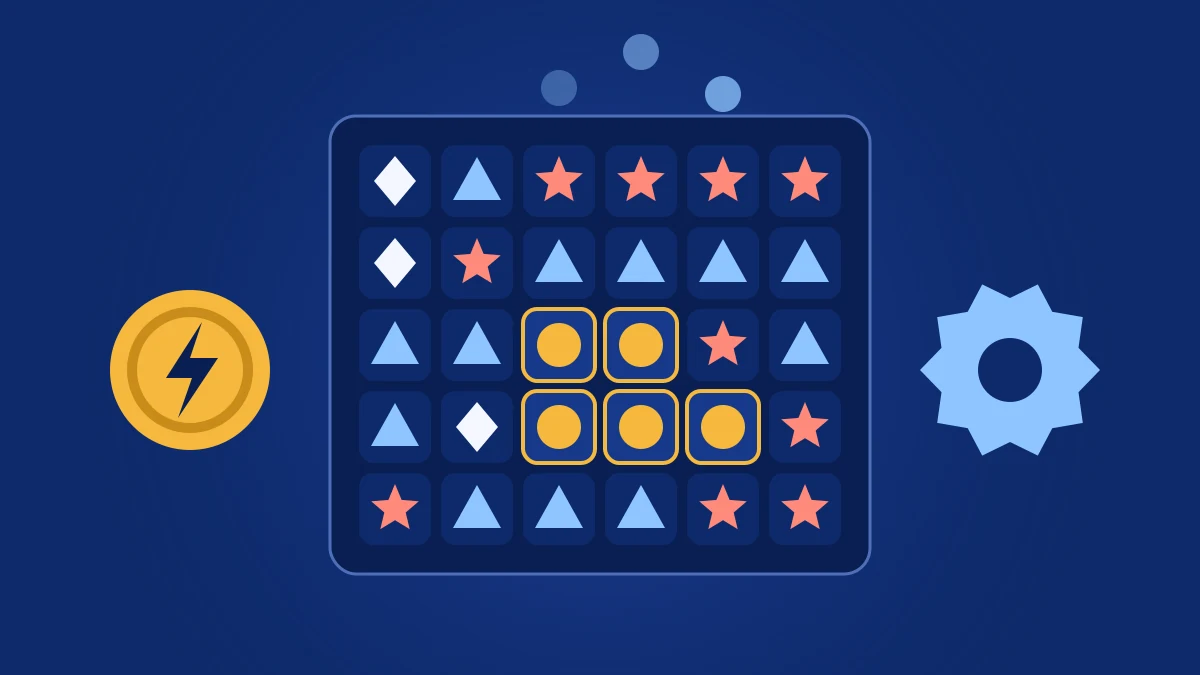
Cluster pays drops the idea of lines and reels altogether. Symbols land on a grid, and a win forms when enough matching symbols touch each other horizontally or vertically, for example five or more connected symbols. Larger clusters pay more. Our Le Bandit review is an example: it pays for clusters of five or more matching symbols connected horizontally or vertically on a six-by-five grid.
Cluster games almost always use cascades. When a cluster wins, its symbols disappear and new ones fall into the gaps, which can form new clusters. Because the grid refills from above, a single spin can reshape the board several times. Some cluster games add features that remove or transform symbols to help clusters form, and others build meters or collection features around the number of symbols cleared.
Scatter pays
Some games pay wherever matching symbols land, with no need for them to be adjacent or on a line. A win simply needs enough of the same symbol anywhere on the grid. In our Gates of Olympus review, a win needs eight or more matching symbols anywhere on its six-by-five grid. This "pay anywhere" style often goes hand in hand with cascading reels, covered next.
How reels behave
Cascades, tumbles and avalanches
In a cascading game, winning symbols are removed after a win and new symbols drop into the gaps from above. If the new symbols form another win, the process repeats, so a single paid spin can produce a chain of wins. Different studios use different names for the same idea: cascades, tumbles, avalanches, rolling reels. NetEnt's Avalanche, introduced with Gonzo's Quest, is one of the best-known versions: symbols fall into place rather than spin, and winning symbols explode to make room for new ones.
Cascades change how a game feels because one spin can keep developing after it lands. They are often combined with multipliers that grow with each cascade, which is where a lot of a game's volatility can come from.
Reel strips and symbol weighting
Behind every reel is a strip: a long, fixed sequence of symbols that the game can stop on. On each spin, the random number generator picks a stop position for each reel, and the symbols around that position are what you see. High-paying symbols appear on the strips less often than low-paying ones, and features may use different strips from the base game. This weighting is how a studio sets a game's RTP and volatility, and it is also why two symbols one position away from a win can look close without the next spin being any more likely to land them.
Respins
A respin re-spins some or all of the reels without a new stake, usually while holding certain symbols in place. Respins are commonly triggered by a special symbol, such as an expanding wild that stays put while the other reels spin again.
Hold-and-win and coin collection
In hold-and-win games, special symbols such as coins stick in place when they land, and you receive a few respins to land more. Each new coin usually resets the respin counter. When the respins run out, the values on the coins are added up and paid. Some games include jackpot symbols that can appear during the feature, and some fill the whole grid for a top prize.
Expanding reels and grids
Some games start with a smaller grid that grows during play, adding rows or unlocking positions as wins or features accumulate. A bigger grid means more ways or more room for clusters, which can make the later stages of a feature much more valuable than the start.
Symbols
Wilds and their variants
A wild substitutes for other symbols to help complete a win. Most games exclude special symbols, such as scatters, from substitution. Wilds come in many forms:
- Expanding wilds grow to cover a whole reel when they land.
- Sticky wilds stay in place for a number of spins, often during free spins.
- Walking wilds move one position each spin until they leave the grid.
- Multiplier wilds multiply any win they are part of.
Scatters
Scatter symbols usually trigger features rather than forming wins on a line. Landing a set number of scatters anywhere on the grid is the most common way to start free spins.
Collectors and mystery symbols
Collector symbols gather the values of other symbols on the grid, such as coins or cash prizes, into a single payout. Mystery symbols land showing a placeholder and then all turn into the same randomly chosen symbol, which can suddenly fill much of the grid with a single symbol type.
Low-pay and high-pay symbols
Most slots divide their ordinary symbols into two groups. Low-pay symbols, often card ranks from 10 to ace or simple shapes, appear frequently and pay small amounts. High-pay symbols, usually themed characters or objects, appear less often and pay more. The balance between the two shapes how a game feels: a game where high-pay symbols are rare and generous will be more volatile than one where they are common and modest.
Oversized and split symbols
Some games use oversized symbols that cover a block of positions, such as two by two or three by three, which can fill several reels at once and create larger wins when they line up. Others use split symbols, where one position counts as two or more of the same symbol, adding extra matches to a ways or cluster count. Both are ways of increasing the size of occasional wins rather than the frequency of ordinary ones.
Multipliers
A multiplier increases a win by a set factor. There are three broad types:
- Per-win multipliers apply to a single win, often attached to a symbol or a wild.
- Global or progressive multipliers apply to every win for a period, and often grow as the feature continues, for example increasing with each cascade or each free spin.
- Random multipliers land on the grid or are applied by the game at random, sometimes very large.
Multipliers concentrate volatility. A game that offers large multipliers typically pays less on ordinary wins, holding more of its return back for the rare occasions when a big multiplier lands on a big win. Many of the largest outcomes in modern slots come from multipliers combining in this way, which is also why they are so rare. Treat a headline multiplier as the outer edge of what a game can do, not as something to expect.
Free spins
Free spins are the most common bonus feature. They are usually triggered by landing a set number of scatter symbols and award a number of spins played at your current stake without further cost.
What makes free spins valuable is usually what happens inside them. Many games add extra features during free spins, such as sticky wilds, persistent multipliers that do not reset between spins, or special symbols that only appear in the bonus. Retriggers award extra spins if more scatters land during the feature. Some games offer a choice of free-spin modes, trading more spins for smaller multipliers or fewer spins for bigger ones; the average value is usually similar, but the volatility differs. When a game offers that choice, it is worth thinking about your budget rather than the size of the possible prize: more spins with smaller multipliers usually gives a steadier result, while fewer spins with bigger multipliers makes the outcome more of an all-or-nothing affair.
Because so much of a modern slot's return can sit inside its free spins, a session without a bonus can feel much worse than the RTP suggests. That is normal behaviour for a feature-driven game, not a sign that something is wrong.
Feature buys and feature bets
Bonus buys
A bonus buy lets you pay a fixed multiple of your stake to enter the bonus round straight away, instead of waiting for it to trigger. The RTP of a bonus buy is often similar to, or slightly different from, the base game, but the variance is extreme: each buy is one large decision, and the result can be a small fraction of the price or many times it. Our guide to RTP and volatility works through the cost of a bonus buy on Le Bandit as an example.
Ante and feature bets
Some games offer an optional bet that raises the cost of each spin in exchange for a change in how the game behaves, most often a higher chance of triggering the bonus. Hacksaw Gaming's BonusHunt FeatureSpins are one example: on Le Bandit, they cost 3x the stake per spin and make the bonus five times more likely to trigger. Feature bets change how often the feature arrives, not the long-run cost of play in your favour.
Bonus buys and feature bets are restricted or unavailable in some markets and at some casinos, so availability varies by jurisdiction.
Studio signatures
Many studios are known for particular mechanics. Here are a few, described in general terms; each game's paytable has the exact rules.
Nolimit City brands its signature features as xMechanics. xNudge nudges wilds step by step while raising a multiplier; xWays reveals several copies of a symbol to expand the ways to win; xSplit splits symbols to multiply the positions on the grid; and xBomb uses an exploding wild that clears surrounding symbols and triggers cascades.
Hacksaw Gaming's Le series is built around Golden Squares: winning positions are marked, and when a special symbol lands, the marked squares reveal coins, multipliers and collectors. Our Le Bandit review explains the full sequence.
Play'n GO's Reactoonz series uses a large cluster grid of alien characters with cascading wins and a meter that charges up modifiers which change the grid.
Pragmatic Play is known for formats that combine scatter pays and tumbling reels with multipliers, as in Gates of Olympus, where multipliers add up during a tumble sequence.
NetEnt's Avalanche made falling symbols a mainstream mechanic, and the studio is also known for Cluster Pays.
Big Time Gaming created Megaways, now licensed to many other studios.
Jackpots
Jackpot slots add a large top prize to the game. A fixed jackpot is a set prize written into the paytable. A progressive jackpot grows with every qualifying bet, sometimes across a single game and sometimes across a network of games and casinos, until someone wins it.
Because part of each stake funds the jackpot, the rest of the game, its ordinary wins and features, usually returns less than a comparable game without a jackpot. The headline RTP of a jackpot slot often includes the jackpot's contribution, which means part of the advertised return comes from a prize almost every player will never win. Our guide to RTP and volatility explains why that matters.
Max-win caps and gamble features
Max-win caps
Most modern slots cap the most a single spin or feature can pay, expressed as a multiple of the stake. When the cap is reached, the round usually ends and pays the capped amount. Caps are rare events: they tell you how far a game can go, not what it is likely to pay. A very high cap is a strong hint that a game is high volatility.
Gamble features
Some slots let you gamble a win after it lands, for example by guessing the colour of a card to double it or lose it. At even-money odds, a gamble feature does not improve your expected return: on average you get back what you risk, and often slightly less. It simply makes each result more extreme. If you use it, do so knowing it adds risk rather than value.
How mechanics change the feel of a game
Put the pieces together and you can see why two games with the same RTP can feel so different.
A game with many ways to win, frequent small payouts and modest multipliers usually has a high hit frequency and low to medium volatility: your balance moves gently, and a budget tends to last. A game built around cascades, growing multipliers and a free-spins round that holds most of the return usually has a lower hit frequency and high volatility: long quiet stretches, and occasional large results. Feature buys and feature bets push that further by concentrating the game's variance into fewer, bigger decisions.
None of these designs is better or worse in itself. They suit different players and different budgets. What matters is choosing a game whose behaviour matches what you want from a session, and budgeting for how it actually plays rather than for its best possible outcome. You can compare games in our slot reviews, which list each game's RTP, volatility and key mechanics.
Reading a paytable
Every slot has an information or paytable screen, usually behind an "i" or menu icon, and it is the best single source of truth about a game. It is worth a minute before you play. Look for:
- How wins are formed: paylines, ways, clusters or scatter pays, and the minimum needed for a win.
- What each symbol pays, and which symbols are wild or scatter.
- How the features work: what triggers free spins, how multipliers behave and whether they reset.
- The RTP of the version you are playing, which can differ between casinos.
- The maximum win, and what happens when it is reached.
- Volatility, if the studio rates it.
- Bonus buy or feature bet prices and their RTPs, where these options are offered.
- Rules for interrupted games, such as what happens if your connection drops during a feature.
If a game's information screen is missing key details, or contradicts what a review says, trust the game's own screen for the version in front of you.
Turbo, quick spin and autoplay
Many slots offer turbo or quick-spin modes that shorten each spin's animation, and autoplay, which spins repeatedly without you pressing the button. Neither changes the RTP or the odds of any spin. What they change is pace: more spins per hour means more money wagered per hour, and with it more expected cost per hour. Autoplay can also make it easier to lose track of how much you are spending. Some markets restrict or ban these features for that reason. If you use them, set a loss limit and a spin count before you start.
Mechanics and bonus wagering
If you are playing through a casino bonus, mechanics matter in a different way. Bonus terms often exclude feature buys, cap the stake per spin and sometimes exclude specific games altogether. A high-volatility game built around a rare bonus round makes it harder to finish a wagering requirement before your balance runs out, while a lower-volatility game with frequent small wins tends to make a balance last longer. Our guide to casino bonuses explains wagering, game contribution and how to judge whether an offer is worth taking.
Slot mechanics glossary
| Term | Meaning |
|---|---|
| Ante bet | An optional extra stake that changes how a game behaves, usually raising the chance of a bonus |
| Avalanche | NetEnt's name for falling symbols that replace winning ones |
| Base game | The ordinary spins outside any bonus feature |
| Bonus buy | Paying a multiple of the stake to enter the bonus round directly |
| Cascade | Winning symbols are removed and new ones fall into their place |
| Cluster pays | Wins formed by groups of touching matching symbols |
| Collector | A symbol that gathers the values of other symbols into one payout |
| Expanding wild | A wild that grows to cover its whole reel |
| Feature bet | An optional bet that alters feature frequency or behaviour for a higher cost |
| Fixed jackpot | A set top prize written into the paytable |
| Free spins | A bonus round of spins played at your stake without further cost |
| Gamble feature | An option to risk a win for a chance to increase it |
| Hit frequency | The share of spins that return any win |
| Hold and win | A feature where special symbols stick and respins are awarded to land more |
| Max win | The most a single spin or feature can pay, as a multiple of the stake |
| Megaways | A ways mechanic in which each reel shows a random number of symbols every spin |
| Multiplier | A factor that increases a win |
| Multiplier wild | A wild that multiplies any win it is part of |
| Mystery symbol | A symbol that turns into a randomly chosen symbol after landing |
| Nudge | A mechanic that shifts a reel or symbol by one position |
| Paylines | Fixed patterns across the reels that must show matching symbols to win |
| Paytable | The in-game screen listing what each combination pays and the rules |
| Progressive jackpot | A jackpot that grows with every qualifying bet until it is won |
| Respin | A re-spin of some or all reels without a new stake |
| Retrigger | Landing the trigger symbols again during free spins to win extra spins |
| RTP | Return to player: the long-run percentage of stakes a game pays back |
| Scatter | A symbol that pays or triggers features wherever it lands |
| Scatter pays | Wins formed by enough matching symbols anywhere on the grid |
| Sticky wild | A wild that stays in place for several spins |
| Tumble | Another name for cascading reels |
| Volatility | How a game's return is distributed: frequent small wins or rare large ones |
| Walking wild | A wild that moves one position each spin |
| Ways to win | Wins formed by matching symbols on adjacent reels, anywhere on each reel |
| Wild | A symbol that substitutes for others to complete a win |
Play responsibly
Mechanics make slots exciting, and some of them, such as feature buys, fast cascades and big multipliers, can also make a budget disappear quickly. Decide on a deposit limit and a time limit before you start, choose games whose volatility suits your budget, and stop when you reach either limit. Never chase losses, and treat large multipliers and max wins as rare outer limits, never as a reason to keep playing. See our responsible gambling page for general guidance. 18+ only. Terms apply, and availability of games and features varies by jurisdiction.
How we review slots at NextCasinoScout
Our slot reviews explain each game's mechanics in plain language, alongside its highest published RTP, its volatility, its max win and its main features. Where a figure comes from a third party rather than the provider, we say so. Read more about our approach on our About page.
Slot mechanics FAQ
Do more ways to win mean better odds?
No. A game's paytable is calibrated to its number of ways, so more ways usually means smaller individual wins. More ways changes how a game feels, not its RTP.
What is Megaways?
A ways-to-win mechanic in which each reel shows a random number of symbols every spin, typically two to seven on six reels, for up to 117,649 ways. Big Time Gaming created it and licenses it to other studios.
What is the difference between cluster pays and scatter pays?
Cluster pays needs matching symbols to touch each other. Scatter pays counts matching symbols anywhere on the grid.
Are cascading reels better?
Not in value terms. Cascades let one spin produce several wins, which changes the rhythm of a game, but the RTP is set by the game's maths as a whole.
Is buying the bonus worth it?
A bonus buy usually has a similar RTP to the base game but much higher variance per buy. It costs a large multiple of your stake, and it is restricted in some markets.
Do jackpot slots have lower RTP?
The rest of the game usually returns less, because part of each stake funds the jackpot. The headline RTP often includes a jackpot most players will never win.
Does the gamble feature improve my chances?
No. At even-money odds it does not improve your expected return; it only makes each result more extreme.
Which mechanic has the highest volatility?
Games built around large multipliers, growing features and bonus buys tend to be the most volatile. Check the volatility rating in the game's info screen where one is given.